
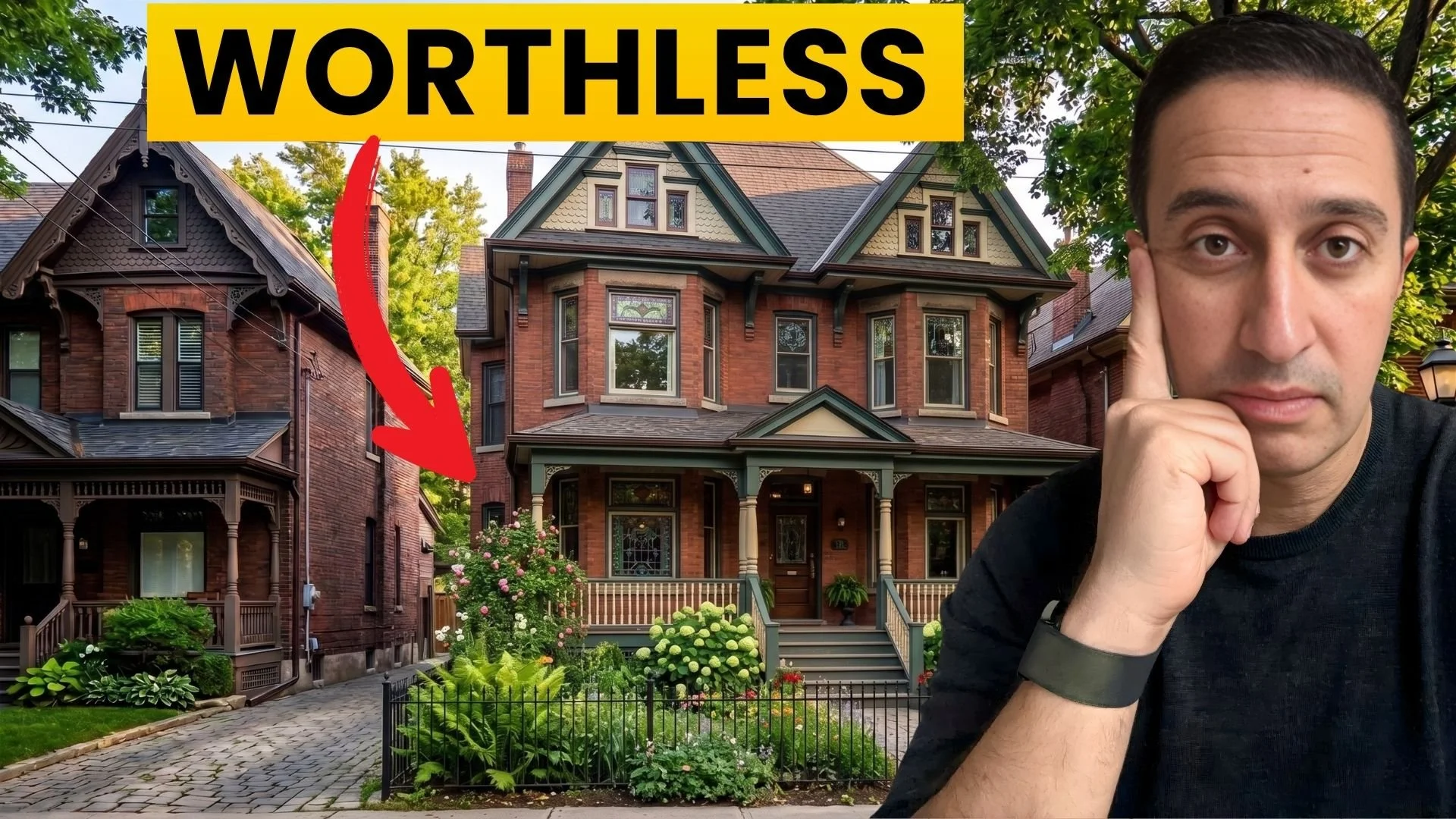
These Homes Are Practically WORTHLESS Now in Toronto

Certain houses in Toronto are sitting on the market for 90 plus days with zero offers because they have major compromises like a busy road location, outdated knob and tube wiring, or defective layouts. In the eyes of cautious 2026 buyers, these specific compromised homes have become practically worthless and completely frozen. While turnkey, move-in ready properties still sell, buyers now have choices and leverage. To make these homes sell, properties must be priced to reflect their physical or structural realities.

The Reality of the 2026 Toronto Housing Market

The current housing landscape in the city of Toronto is completely different from the peak of the market a few years ago. Back in 2021 or early 2022, a seller could put a for sale sign on a property, hold an offer night, and easily get multiple offers. The market was so starved for inventory that buyers were forced to ignore massive structural flaws just to get a foot in the door.

In 2026, the city of Toronto market has split into two distinct tiers. Turnkey, move-in ready homes are doing just fine, but if a house has even one major compromise, the market ignores it. Data from the Toronto Regional Real Estate Board reveals that the sales to new listings ratio has dropped to 36.1%. Anytime that ratio drops below 40%, the market is firmly in a buyer market. While the average house takes about 54 days to sell, compromised homes are sitting much longer.

Five Types of Toronto Houses Getting Punished

A dividing line exists in the local market. Five specific property types face severe penalties from buyers who refuse to take on unnecessary stress or costs.

1. The Busy Road Trap

Properties sitting directly on major busy streets like Bathurst, Keele, Eglinton, or Dufferin are practically dead in the water. During the peak market, buyers would compromise on traffic noise because they could not afford premium areas like High Park. Today, when buyers can look at five other homes on a quiet side street or a cul-de-sac in the same price range, they walk away from busy roads every single time.

Owning a home on a major four lane road carries a permanent location tax. In a balanced or buyer-leaning market, that tax is paid in the form of a price discount. Buyers simply do not want car noise in their living room or the nightmare of backing out of a driveway into morning rush hour traffic.

2. Homes Bordering Rail Corridors

The city of Toronto is carved up by train tracks, including GO Transit corridors, CP Rail lines, and CN freight lines. These tracks cut right through heavily populated neighbourhoods like the Junction, Davenport, Leslieville, and Riverdale. Metrolinx is constantly expanding and increasing the frequency of the GO Transit network, alongside the ongoing construction of the Ontario Line.

When a buyer stands in a backyard and feels the ground vibrate as a train rumbles past, they worry about future expansion. They wonder if there will be twice as many trains passing by their bedroom window in five years. This fear creates a wide value gap between rail bordering homes.

3. The Outdated Wiring Nightmare

Problematic wiring like active knob and tube or older aluminum wiring is common in older Toronto houses in places like the Annex, Bloor West Village, or Riverdale. Insurance companies have become incredibly risk-averse. Many major insurance providers will outright refuse to write a policy for a house with active knob and tube wiring.

If a buyer cannot get home insurance, their lender will not fund the mortgage. This turns a simple purchase into a financing nightmare where the buyer risks losing their deposit. Fixing this requires an electrician to rip open drywall, rewire the entire house, and get an Electrical Safety Authority certificate. In a standard Toronto two-story home, that is easily a $15,000 to $30,000 job that creates plaster mess and requires full repainting.

4. Obsolete or Defective Layouts

Defective layouts are a massive roadblock in today's cautious market. Examples include semi-detached homes where you must walk through the second bedroom to get to the third bedroom, houses with only one bathroom, or properties with drafty additions slowly sloping away from the main structure. In a hot market, people convinced themselves they could deal with these issues down the line.

In 2026, permits, construction, and labour costs in Toronto remain incredibly high. Ripping down an addition, relocating plumbing, or restructuring a floor plan is a massive financial undertaking. Buyers calculate the cost of fixing the layout, add a 30% to 40% buffer for surprises in older homes, and realize it is easier to buy a properly laid out property down the street.

5. Overpriced Homes Clinging to the Past

This is the single biggest reason homes sit on the MLS for over 90 days. Some sellers are still trying to play the 2021 game by listing their home significantly under market value, expecting crowds to show up on offer night and bid the price up by $200,000. When offer night arrives to complete silence, these sellers terminate the listing, relist it at their dream price, and refuse to budge.

This strategy leaves the home looking stale on the market with a history of termination. Buyers smell opportunity when a listing sits. Sellers end up chasing the market down and selling for less than if they had priced it realistically on day one.

The Playbook for Sellers

If you own a flawed property, you can still achieve a successful sale by adapting to current market realities.

First, obtain a pre-listing home inspection. Do not let the buyer find the knob and tube wiring or an active roof leak on their own. Find the issues first, get professional quotes to fix them, and present those quotes to potential buyers. Better yet, hire an electrician to fix the wiring defects before hitting the market to safeguard your sale.

Second, price the property right from day one. Look at recent comparable sales, deduct the actual cost of the flaw, and price it realistically. A home priced correctly for its flaws will still attract buyer attention and sell.

The Golden Era for Buyers

For years, buyers were pushed around, forced to submit firm offers with no conditions, and told to pay way over the asking price. The current market presents an excellent opportunity to get deep discounts.

If you have a reliable contractor, look for homes that have been sitting for over 90 days due to a bad layout or outdated wiring. Write an offer with clear conditions for financing, home inspection, and home insurance. Take the estimated cost of rewiring or repairing the house, double it and knock that entire amount off your offer price. Stressed sellers are often willing to say yes just to move on with their lives. No home in Toronto is truly worthless, everything sells when the price matches the reality of the property.
You Won't Believe What Happened To Toronto Real Estate | May 2026 Market Update

If you are waiting for the Toronto housing market to completely crash, May's data just threw a massive wrench in that plan. While average prices are down slightly, buyers actually stepped up the pace, pushing total sales up over 6% compared to May of last year. At the same time, sellers held back, causing new listings to plummet by nearly 19%. This shift means the broad crash many anticipated has not materialized, though market directions depend heavily on whether you look at detached homes or downtown condos.

Understanding these dynamics requires looking closely at local numbers across the city. Broad regional statistics fail to tell the true story because real estate is extremely local. Here is the exact data you need to know if you plan to sell your home or contemplate buying a property this summer.

Analyzing the Overall Toronto Regional Real Estate Market

The Toronto Regional Real Estate Board covers a very wide geographic area. To be exact, the board tracks seven regions in total, which creates a highly diverse statistical mix. For our focus, we are narrowing the data down to the city of Toronto only, specifically looking at detached houses, semi-detached houses, and the condo market.

Across the broader region, sales went up by 6.3% in May of 2026 compared to May of 2025. This increase brought the total number of sales to just over 6,500. While a 6% increase sounds good on paper, we have to look at the broader picture regarding the new supply of properties coming onto the market. New listings dropped by approximately 19% during the month of May.

Sellers, whether they are home sellers, investment property sellers, or condo sellers, have held back. They are choosing not to list their properties, likely because they understand current market conditions will not net them the specific number they are looking for. Consequently, active listings dropped by 13.3% across the board.

The average price in the whole region dropped by 4.6%, though I do not put too much weight into that figure. Because it takes all seven regions into account, it obscures the reality of local neighborhoods. Meanwhile, listing days on market went up from 25 to 27 days. Property days on market, which includes all cancellations and relistings, rose from 39 to 42 days, proving it is still taking longer to sell a property.

The High Level Historical Perspective

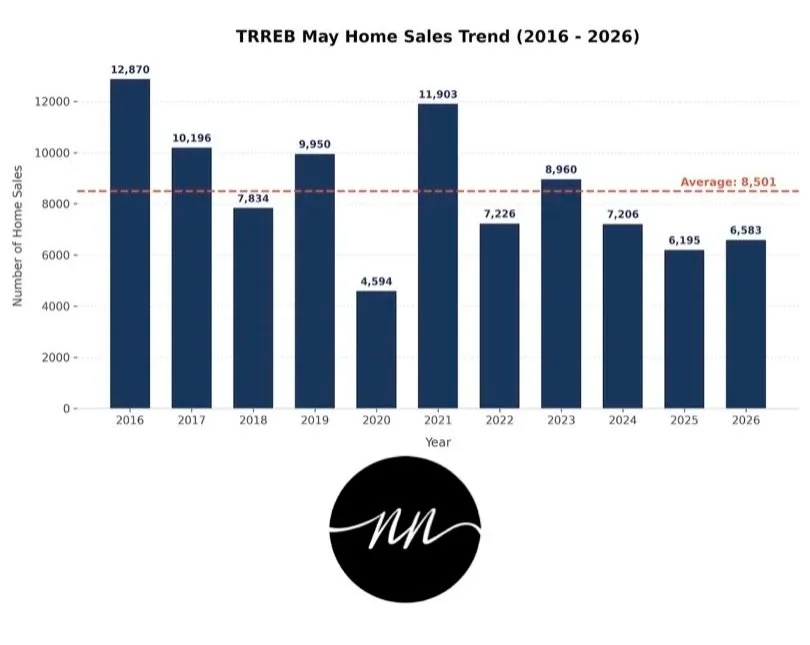
Although sales in the month of May reached 6,583, they are still 23% below the 10-year average of 8,501 for the month of May. This fact is important to keep in mind because this tracking period represents the third lowest sales year in those 10 years.

If we remove May of 2020 from the data, which was when the whole world was shut down, May 2026 actually represents the second worst sales volume over the last 10 years. The year 2025 brought the lowest sales in over 25 years. While activity improved this year, staying 23% below the 10-year historical average shows that the market is still operating at a slower historical pace.

City of Toronto Breakdown by Property Type

When we isolate the 416 area code to look at the city of Toronto only, we see distinct patterns by property type:

  • Detached home sales were up 8.9% compared to May of 2025.

  • Semi-detached home sales increased by 2.5% over last year.

  • Condo market sales rose by 4.2% year over year.

Having said that, average prices went down across the city. In the city of Toronto, detached average prices fell 6.5%, while semi-detached prices remained flat with a minor negative 0.6% change. Condo average prices were down 5% compared to May of 2025.

The Freehold Market: Detached and Semi-Detached Homes

The detached property segment currently shows 3.27 months of inventory. In real estate terms, between four and six months of inventory is considered a balanced market. Anything under four months tips directly into sellers' territory, while anything over six months gives buyers the distinct advantage.

Currently, 31 out of every 100 detached homes listed are selling. The average price for a detached home in the city stands at 1.6 million dollars, with a median price of 1.3 million dollars. The 8.9% increase in sales shows that buyer demand for detached properties remains stable despite pricing adjustments.

The Competitive Semi-Detached Segment

With respect to semi-detached properties, inventory is much lower, meaning there is less product to choose from overall in the city of Toronto. The segment sits tight at 1.84 months of inventory, and 54 out of 100 semi-detached homes sold in the month of May. The average price is $1,293,000, with a median price of $1,119,000.

Semi-detached homes represent a major transition point for buyers moving from the condo market to detached properties. They offer young families a practical option with no condo fees, ground-level housing, front driveway parking in some cases, and a decent backyard for the kids to play in.

Inside the Toronto Condo Market: Understanding the Three Sub-Markets

The condo market presents a completely different landscape. The official months of inventory sits at 5.44 months. Although this technically registers as a balanced market because it falls between four and six months, it is actually still heavily in the buyer's favor.

The average price for a city condo is $673,000, with a median price of $565,000, even as sales increased by 4.2%. To understand why buyers hold the upper hand, you have to look beyond the standard MLS data. There are actually three distinct condo markets competing with one another right now.

1. The Resale MLS Market

This is the traditional market where individual condo owners place their properties up for sale. It is the most visible market, but it only represents one layer of available supply.

2. The Builder Supply Market

Developers are sitting on finished, unsold units that they are highly motivated to move. Builder sales have increased due to government incentives, specifically the HST rebate or waiver of up to 130,000 dollars. Builders can offer this significant financial incentive to individual buyers, creating fierce competition for resale sellers.

3. The Assignment Market

The assignment market consists of pre-construction buyers who purchased condos years ago. As these buildings near completion, these buyers face taking title and closing on the properties. Those who cannot close are desperately trying to assign their contracts before final completion.

The HST rebate heavily penalizes the assignment market because that $130,000 waiver is not applicable to an assignment sale. This limitation puts further downward pressure on assignment sellers, leaving buyers with a massive amount of supply, numerous options, and the upper hand in negotiations.

A Closer Look at the Downtown Condo Core: C1 vs C8

To understand the core condo market, we look at the specific real estate zones C1 and C8. The C1 zone runs from Yonge Street to Dufferin Street, from Bloor Street down to the lake. The C8 zone runs from Yonge Street east to the DVP, from Bloor Street down to the lake.

Data shows there are significantly more condos and higher sales volumes west of Yonge Street:

  • Sales Volume: C1 (West of Yonge) had 253 sales, while C8 (East of Yonge) had 131 sales.

  • Active Listings: C1 finished May with 1,863 active listings, compared to 793 active listings in C8.

  • Average Price: The average price is higher west of Yonge at 737,000 dollars, compared to 631,000 dollars east of Yonge.

For buyers, the east side of Yonge Street provides a more affordable entry point into downtown living, even though there are fewer total options available.

When reviewing these figures, do not put too much weight on the sales-to-listing-price ratio, which sits at roughly 97%. This ratio only reflects the final list price. If a seller lists at $800,000, terminates, relists at $750,000, terminates again, and finally lists and sells at $700,000, the ratio only compares the $700,000 sale price to the last list price. It does not reflect the true pricing journey of that property. Condos in the core average 30 to 33 days on market for their final listing, though the total process often takes several months.

Strategic Advice for Buyers and Sellers This Summer

If you are a seller navigating the detached or semi-detached market, conditions are gradually shifting toward your advantage. Depending on your specific location and how well your house shows, you could face multiple offers and active competition from buyers.

If you are a buyer looking to acquire freehold, ground-level housing, recognize that inventory is shrinking and choice is becoming limited by neighbourhood. If you financially qualify, possess secure employment, and have been sitting on the sidelines, take advantage of the current market to buy your long-term home. Plan to live in that specific property for at least seven years.

For condo sellers, you must stay one or two steps ahead of the market trend. Review what has sold and what has been terminated over the past 30 days, and adjust your pricing to meet where buyers will realistically be 30 to 45 days from now.

Condo buyers should recognize they have immense leverage. Negotiate hard, secure your target price, and include all necessary conditions. When shopping, prioritize a functional floor plan layout. Excellent layouts make a massive difference in daily living and will heavily impact your resale value down the line.

If you want to discuss your specific situation reach out.

Click Here For Video

Why Is Toronto's Real Estate Market Stuck? ⏳

Why Is Toronto's Real Estate Market Stuck? ⏳

Toronto real estate market update April 2025: Why is the real estate market stuck?

The Challenges of Selling a Tenanted Property: A Guide for Home Sellers

The Challenges of Selling a Tenanted Property: A Guide for Home Sellers

Selling a Tenanted Property can be challenging. I discuss 5 factors to consider when considering selling your rental property.

The Impact of Property Tax Increase

The Impact of Property Tax Increase

The Impact of Property Tax Increase

The property tax hike will specifically impact business owners, homeowners, real estate investors, and tenants. Let's delve into the details and understand the potential consequences.

Toronto's January Real Estate Market Report & Interest Rate Cuts

Toronto's January Real Estate Market Report & Interest Rate Cuts

Toronto's January Real Estate Market Report & Interest Rate Cuts

Sales were up in January 2024. In this video, we'll take a look at: 1/ What happened in Toronto's real estate market in January 2024 2/ When will the Bank of Canada cut its benchmark rate

The Monthly Toronto Real Estate Insights - Jan 2024 Edition

The Monthly Toronto Real Estate Insights - Jan 2024 Edition

January 2024 Toronto Real Estate Insights: Toronto Vacant Tax, Property Tax, Land Transfer Tax updates and Interest rate cuts

Interest Rate Hikes Are Done: 3 Things You Need To Know

Interest rate hikes have come to an end, and it's essential to understand the implications of this development. In this blog post, we'll explore three crucial questions about interest rates moving forward into 2024. As a real estate broker in Toronto, I'll provide you with insights and analysis to help you navigate the changing landscape. So, let's dive in!

What Does This Mean for Homeowners, Buyers, and Sellers?

Based on what economists are saying, rate hikes have reached their peak, accompanied by concrete data showing a slowdown in the economy. As we observe contracting GDP and a rise in unemployment, it's crucial to understand how this impacts the real estate market. For homeowners, this means a steady environment with predictable interest rates. Buyers may find it favorable to enter the market as rates stabilize, while sellers should be prepared for a potentially more balanced market.

When Will Interest Rates Come Down?

This is the million dollar question for many. Economists believe that interest rates will start to come down in the second half of 2024. There are three Bank of Canada rate announcement dates to keep an eye on April 10th, June 5th, and July 24th. It is expected that the Bank of Canada will gradually cut the benchmark rate, providing some relief to borrowers. However, it's important to stay updated and monitor these announcements to make informed decisions.

When Will the Real Estate Market Pick Up?

The timing of the real estate market's recovery is uncertain and hinges on the balance between buyer and seller actions. Will buyers and sellers take action in the spring market of 2024, driven by concrete data of a slowing economy and declining inflation? Alternatively, will they wait for the first Bank of Canada rate cut announcements or statements? The spring market of 2024 will serve as a critical period to assess market dynamics. While the market may remain slow in the coming weeks leading up to the Christmas break and New Year, it's difficult to predict what will happen beyond that point. The first move—whether by the Bank of Canada or buyers and sellers themselves—will shape the industry's future landscape.

Interesting Fact: Inflation and the Bank of Canada's Role

Inflation in 2023 stood at 3.1%, but if we strip out mortgage interest from this equation, inflation would sit at 2.2%. This raises an intriguing question: is the Bank of Canada contributing to inflation or solving the problem? It's food for thought and a topic worth exploring further.

Conclusion

Navigating the real estate market amidst changing interest rates and economic conditions requires careful consideration. Whether you're a home buyer, seller, or investor, it's essential to understand how these developments impact your unique situation. If you're unsure about what steps to take, don't hesitate to reach out to me. As a real estate broker, I'm here to assist and provide personalized advice tailored to your needs. The future of the real estate market is uncertain, but with the right information and support, you can make informed decisions.

Thank you for taking the time to read this blog post. Stay tuned for more updates and valuable insights. Until next time!

If you have any questions or would like to discuss your personal real estate situation, feel free to reach out to me. I'm here to help.

Toronto Homes Under $1 Million West of Yonge

Toronto Homes Under $1 Million West of Yonge

Toronto Homes Under $1 Million West of Yonge

September 2023 Toronto Real Estate Market Analysis

In this comprehensive analysis, we highlight four key observations that shed light on the current state of the real estate market.

1. The Sales Activity has been Decreasing

In May 2023, there were just over 9,000 sales, whereas September had 4,600 sales. That is a 50 % drop. Now typically, we would see an uptick in sales in the month of September, because that would be the beginning of the fall real estate market. However, we did not see that. The actual numbers for August were higher in sales figures compared to the month of September. This speaks to the headwind the real estate market is facing due to the lack of affordability, which is driven by higher interest rates.

2. Active and New Listing has been Increasing

The number of active and new listings has been increasing faster compared to the number of sales. This leads to higher months of inventory: It will take longer for these properties to sell and eventually as more supply sits on the market, there will be downward pressure on prices moving forward.

3. Affordability Challenge

We have had 53,000 sales up till September 2023. In the greater Toronto area, 82 % of those of sales have been under $1.5 million which again speaks to the lack of affordability due to higher interest rates.

4. Lowest Sales since 2010

Overall, 2023 looks like it has the lowest sales since 2010. Last year we had 75,000 sales. So far in this year, we've had 53,000 and it looks like we will end up around 70-72,000.

2024 Rent Increase Guidelines Ontario

Real estate investors, for 2024 you are allowed to increase rent by 2.5% based on the 2 following criteria:

  1. You have to provide 90 days notice from the end of the month via N1 form. For example, if you intend to increase rent on Jan 1, 2024, the latest date to provide the N1 form is Sep 30, 2023 not Oct. 1, 2023.

  2. You are only allowed to increase rent once per 12 month period. For example if the landlord has increased rent by 2% in July 2023, they’ll have to wait till July 1, 2024 to increase rent by up to 2.5% with N1 notice no later than the end of March 2024 to account for the 90 day notice requirement.

There are 2 exemptions to rent control:

  1. New buildings, additions to existing buildings and most new basement apartments that are occupied for the first time for residential purposes after November 15, 2018 are exempt from rent control. For these rental units, N2 form is be used

  2. The guideline does not apply to certain types of units including:

  • community housing units

  • long-term care homes

  • commercial properties

  • vacant residential units. Once the tenant moves out, the landlord can reset the rent to the current market value at that time

As a landlord, you do not have to increase rent by the full 2.5%. Every scenario is unique. If you’ve had your tenant for a long time and your current rent is well below market rent, it makes sense to increase by the full 2.5%. 3 factors to consider when deciding by how much to increase rent by:

  1. The quality of the tenant and how well they’ve been taking care of the property

  2. Increase in expenses such as mortgage payment, property tax, utilities and insurance

  3. Current market rents in the area

Here are links to the N1 form , N2 form and Government of Ontario’s rental increase guidelines.

And until next time…..happy investing!!

5 Real Estate Investing Lessons from The Psychology of Money

5 Real Estate Investing Lessons from The Psychology of Money

5 Real Estate Investing Lessons from The Psychology of Money

What Not To Fix When Selling Your House. 6 Things To Wow Buyers

In the world of 140 characters, reels and swiping…first impression is critical especially when selling your house. Here are 6 things you can do to wow buyers.

Let’s go through 6 things to wow buyers when selling your house

  1. Paint. Living in a house for years with kids, pets and daily wear & tear, there will be scuff marks, dents and nail holes. A fresh coat of paint makes a world of difference. I have kids and for some reason, there seems to be always a new a surprise on the walls.

  2. Light fixtures. They will modernize and brighten up the space. Have you ever walked into a house, turned on the lights and the house was still dark or had yellowish lights? You don’t get the best feel for that room right? Making a good impression for a potential buyer is the goal here.

  3. Door handles/fixtures. I’m referring to the basic round builder door knobs here. They need to go. Also tighten up loosen door handles. Opening and closing doors or closets should feel sturdy. It gives a solid feel for the house.

  4. House Functions. Walk through the house and review the mechanicals to ensure they do not need major work. For example, if you have a leaky roof, get it fixed, repair any damaged drywall and keep the receipts. Inspect and make sure there are no issues with the furnace, air conditioning unit and electrical outlets. As a seller you don’t want to plant seeds of hesitation in a potential buyer’s mind. If there are ungrounded outlets, the potential buyer might question the electrical wiring of the house and what they might be getting into. That buyer could put a low ball offer since they believe they have to budget for potential surprises and repairs.

  5. House Ambience. Work with your real estate agent and stager to declutter, depersonalize by removing all personal photos & memorabilia. Leave the space for the potential buyers to visualize living and entertaining in the house.

  6. Landscaping. This action items depends on time of year when you’re selling your house. If you’re selling in the spring, summer or fall don’t forget to do a landscaping clean up.

Here are two bonuses for you, well for you to expect from your real estate agent:

  1. Cleaning. Your real estate agent will have the house professionally cleaned. There is no room for error. No second chance if a potential buyer sees a furball. The house needs to be spotless.

  2. Photos. Ok this is a pet peeve of mine. No photos using smartphones, only professional photographers who will present the house at its best. Put yourself in the buyers agent or buyers shoes scrolling through MLS listings online. If the photos don’t show well, they will not consider setting up a showing appointment. You only have a few seconds to make a great online impression for the buyers to setup an appointment to see the house in person. You would be surprised how many times I have seen photos of houses for sale using a smartphone. Please stop.

If you’re looking to get your house ready for sale, download my seller’s guide.

Should You Renovate or Buy a New House?

This is the million dollar question. Hopefully it won’t cost a million to renovate your house!!

Are you outgrowing your space and wondering if you should renovate or a buy a new house? I'll walk you through 6 factors to consider if you renovate your house and 6 factors if you buy a new house.

Let’s take a look at factors to consider for each scenario. First renovate your house:

  1. Timeline: Allow for adequate time for getting designs, permits and renovations completed. This could take up anywhere from a year to a year and a half depending on the extent of the renovations. I am referring to gutting the house, doing an addition, adding a third floor, underpinning the basement….major work and not cosmetic such as redoing a few bathrooms

  2. Budget: Whatever you budget for add another 25-30%. There are always surprises, additional issues to address and changing cost of labour and material

  3. Contractor: I highly, let me say that again, highly recommend you pick the contractor early in the process. You might be asking how if you don’t have designs completed for the contractor to quote. Ask for referrals from friends and family who have done extensive renovations, interview the contractor, search them online and ask for past clients references. It’s important to have the contractor provide input to the design process since they are responsible for doing the renovations. Anything can be designed on paper, however if it’s difficult to build, it will add significant costs

  4. Accommodations: This is something to plan and budget for. If your renovations will take 8-12 months, account for renting another home while renovating your house 

  5. Location: You get to stay in the area you have roots in

  6. Long Term Home: The reward of this process is you get to design and build your long term home. The finishes, the features will make this a long term home for your family. A place to entertain, host and live.

Ok let’s look at buying a new house:

  1. Buy & sell: depending on market conditions you will either have to buy first then sell or vice versa. Be prepared to declutter your current home and get it ready for sale

  2. Moving: Decluttering, purging, packing, moving and unpacking with young children can be a challenge. Speaking from personal experience, I find building a house from scratch is a lot easier than moving with young kids but it had to be done

  3. Features & Finishes: It might not be the perfect house in terms of wall colours or choice of tiles, however minor cosmetic changes can be done before you move in or down the line

  4. Finances: Some of the costs to consider are land transfer taxes, legal fees, selling fees, moving fees and any mortgage penalty fees

  5. Neighbourhood: You might buy a house in the desired school catchment area where you want your kids to go to school to

In summary, if you live in a condo which is your first home, buying a house is pretty much your only option since you are outgrowing the space. If you live in a house then either option could work for you. It really depends on what your preference is to love it or sell it.

If you have outgrown your space and are looking to move a bigger family home reach out. I have helped many clients and have personally moved with young kids.

Financial Freedom is One Property Away!!

Financial Freedom is One Property Away!!

How is that retirement planning coming along? I’ll show you how one investment property will help you achieve financial freedom. Yes, 1 not 10.